Discussion between Material Science and Buddhist Science, Kathmandu, Nepal
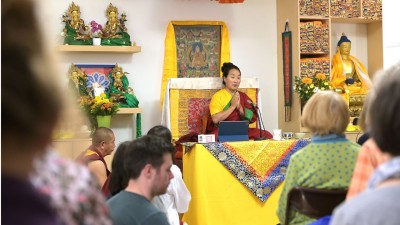
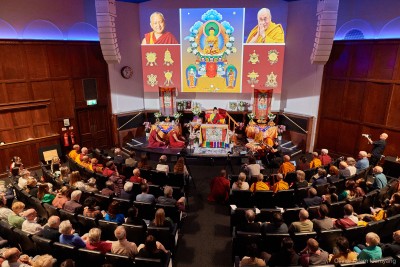
These spontaneous teachings were delivered to a group of esteemed academics from the Mind and Life Institute. They took place on March 25, 2024, at Khandro Rinpoche's residence in Kathmandu, Nepal.Transcript for the teaching video:
The Buddhist teachings are the principal source for peace and happiness in the world. If you look deeply into what peace and happiness is, what other source can truly provide it other than these teachings of exceptional insight and exceptional compassion? These are the hallmarks of Buddhist teachings. They provide a unique possibility for peace and happiness to emerge in the world.
The two streams of teachings of sutra and tantra came to Tibet and survived there for a long period of time. These teachings culminated in the arrival of His Holiness [The Dalai Lama] who then, due to circumstances, had to eventually leave Tibet and settle in India. Due to His Holiness’ vision and kindness, through dialogues such as the one of ‘Mind and Life’, the whole world has been connecting with him. This is especially so because science and Dharma want the same thing, which is to understand the way things really are, the actual basic reality. That is what science ultimately wants and that is what the Buddha Dharma is ultimately about, discovering the truth of that. Through His Holiness’ vision and kindness, through all of these dialogues with scientists over the years, an atmosphere was created where additional respected and amazing scientists could come and meet and engage with him. Their ways and points of view have been meeting with the Buddhist ways and points of view. Now, many leading scientists understand the value of the Buddhist approach to discovering the way things really are. More and more, these scientists come to the conclusion that the way they understand fundamental reality is very much aligned with the Buddhist way of understanding fundamental reality. This beautiful interdependence between scientists and Buddhists has come about through His Holiness’ connection with the scientific world, through his establishment of unbiased and non-sectarian connections with them.
This has been a meeting between different points of view of the study of the material world and the study of the fundamental mind or consciousness; a meeting between those who study matter, or material reality and those who study consciousness or the mind aspect of reality. On the side of the study of material reality, or matter, incredible advancements have taken place. What extraordinary benefits those who study the side of material sciences have produced! Look at all the extraordinary things the world is capable of now through that study. Of course, a lot of destructive potential comes from that study as well, the possibility to destroy a lot of things. Then, on the other side, the study of mind or consciousness is also extraordinary. Why? Because through the study of mind and consciousness one can arrive at exceptional insight – prajñā – which we cannot find elsewhere. Through this field of study, we can clearly understand what suffering is and how to completely eliminate it. We can discover what true lasting happiness and joy is and take it to levels unseen in any other realm, beyond what we can even imagine. This kind of true happiness and joy comes about when one truly learns how to abandon the causes of suffering and accomplish the causes of happiness, then takes that all the way. From the perspective of studying the mind, we can understand how visual form, sound, smell, taste and sensation function, how the mind relates to them and either causes suffering from them or creates the causes of happiness from them. So, through that angle and through that type of study, exceptional and mind-blowing achievements of wisdom and compassion are possible. This is why this dialogue is so important.
It is such an outrageous thing, if we really think about it. On the one angle, the physical body is a product of the three poisons. How did we get this defiled physical aggregate? From the three poisons. Yet it is this very defiled physical aggregate, created by the three poisons, that can completely accomplish the causes of happiness, completely abandon the causes of suffering and even achieve liberation and omniscience. Those two things are both true at the same time.
How many problems do we have on account of our mind, how many emotions, how much suffering, reactivity with attachment and aversion? This is creating endless problems for us in our lives. That is part of the reality. Yet, at the very same time, within that mind there is this way. If the mind is completely authentic and pointed in the right direction, with extraordinary skillful means of bodhicitta and emptiness, it can completely transcend all those problems. How amazing is the skillful means of bodhicitta and emptiness!
However, not seeing these authentic pathways out of our current condition, we experience endless delusion and confusion. How mind boggling! How extraordinary is that? Nowadays, in the world there is this amazing bounty of samsara. Even though that bounty is amazing and there are a lot of pleasures and comforts to be had, it is always limited. On the other hand, if we direct our mind towards the extraordinary true nature of phenomena, the extraordinary true nature of the mind, the happiness and blessings that can come from that are totally limitless. So, we have the ordinary limited happiness, no matter how much bounty can be obtained, then you have this limitless bounty to be had from exploring the nature of reality and exploring the nature of the mind. How extraordinary! It is right there to be seen and yet we don’t see it. We remain deluded. If we can just see it, the benefits will be totally limitless. How extraordinary is that!
Think about the world at large. What could produce peace and happiness in the world? It is this exceptional compassion and wisdom that can come from seeing things in this way. It really has the potential to unleash peace and happiness throughout this world.
(… Khandro Rinpoche is informed that one of the guests is a professor)
Professors, business leaders, doctors, politicians, students and so forth have a great responsibility to bring peace and happiness into the world. It is in their hands because they have all the tools. It is really wonderful to study and develop the knowledge and the skills in this life to the degree that you are in a position to be like a professor. It is kind of like being a lama. Your job is to eliminate the darkness of ignorance in your students and to benefit them. That is similar to the job of a lama, so it is a very kind thing to have taken that path and responsibility in life. Thank you for that.
I don’t use the word lama casually, either. In my opinion, what a lama means is someone who is actively working to dispel the suffering in other beings’ minds. I don’t particularly place any importance on name, reputation, status and things like that. Those things are not what makes a lama. It is the ability to share undefiled insights and dispel the suffering of other beings. That is what a lama really is. Clarifying what is clear to see, what is readily apparent for their students, the hidden aspects of reality, then teaching those aspects clearly. That is what a lama really is supposed to be doing.
If famous scientists come to get interested in Dharma, that is the best thing that can happen to the lamas! The scientific approach, one that studies reality from the angle of science, gets very, very fine and discovers all these amazing things about what the brain is and how it works. Then, when all these different dimensions of studying reality intersect with the Buddhist approach, which studies coarse and very subtle levels of mind and consciousness, things get more and more subtle. Amazing truths about both the course and subtle levels of mind will be discovered. Therefore, the exploration of mind through dialogue can reveal so much about reality. This is a very important and precious endeavor.
This dialogue or meeting is so important because, on the one hand, scientists’ approach matters quite deeply. They know so much and are so precise. They know, for example, on a subtle level how the brain works or how visual consciousness works. It is amazing that they understand this so well. However, that’s what they think consciousness finally is. They don’t know how to go beyond that. Actually, from the point of view of yeshe or primordial wisdom, the true underlying nature of the mind, that level of consciousness they have been studying and mapping out is very coarse. There are so many subtle levels and depths of understanding between basic visual consciousness and primordial wisdom. But they don’t know anything beyond basic sense consciousness. It is amazing that they know how the brain works to that degree, but if people were to think that is the final story of the mind, that is as far as we can go and we should stop there, what a shame that would be! There are so many more subtle layers of wisdom and actual direct experience that people can have, between coarse visual consciousness and our primordial wisdom nature. For example, look at the difference between our waking and sleeping consciousness. When we fall asleep and enter the dream realm, consciousness is more subtle. Then, between the dreaming realm and the fundamental nature, which is just luminosity, there is again all these levels of subtlety and experience. Things get more and more subtle, which can all be experienced and is part of the reality of the mind. How wonderful would be it be if people from the science side can come to accept that. What a shame if they just stop at the coarse sense consciousness!
To understand what things fundamentally are, the scientific approach uses light through microscopes and other technology to study the most subtle particles. This approach ends up at indivisible particles, the smallest building blocks of reality. We could call them subatomic particles. You could conceptually describe different aspects of these in terms of the five elements and in terms of aspects like their heat, movement and so on. That is how the scientists investigate. They think that they are getting to the raw underlying reality, but all of that is only exploring the confused mind. It never goes beyond the confused mind. Even when they go to the fundamental subatomic reality in that way, it still does not touch the wisdom mind. That aspect is inaccessible by that method or approach.
Through that style or approach, trying to understand scientifically by breaking everything down, things like the capacity within the mind to change from confusion to clarity, from ignorance to wisdom, remains inaccessible. How could they possibly understand our method in Buddhism, where we perceive the very same things in an impure, confused manner then transform them within the mind as pure appearances and pure perception? It is extremely difficult to understand. That is why this dialogue is so essential – only the understanding that comes from this Buddhist perspective, which explores the mind from the inside through experiential perception, can lead us there. If one just looks at things from the outside, it is inaccessible. Scientists understand that matter comes down to indivisible particles. Science has already agreed with that, they are already there. They know that you cannot find concreteness within matter when you break it down again and again into its fundamental particles. They know that, but they don’t know from the mind side how to understand the distinction between a confused mind and an unconfused mind. They have not yet explored this experientially. So, even though they have developed an understanding from the outside about the nature of reality, that understanding is still arising within a confused mind. In order to understand beyond that, we have to go through the avenues of inner experience and practice. That is why the dialogue of these two fields of knowledge - mind and material reality - need to co-operate. To really benefit the world, both are necessary.
From my point of view there are two ways that blind faith can operate. The first is when we just ask for things to magically appear from the outside. People will say, “I don’t understand what the causes of happiness are, nor do I understand the causes which produce suffering, but please help me to eliminate my suffering. Please help me to be happy.” Then, when you ask them: “What are the causes and conditions of happiness? What are the causes and conditions of suffering? Why do you like happiness? Why do you dislike suffering? What is interdependence? How does it function?”, they have no answer. They have no idea. They just say, “Please help me” again and again, or “I just want to be happy. Please help me to be happy.” There is no understanding there of what the causality is with happiness and suffering. That is one kind of blind faith.
The other kind of blind faith says, “As long as I cannot see it, it does not exist.” That is also a dangerous kind of blind faith, where someone says that if something cannot be seen and verified themselves, it cannot exist. Then they totally deny and reject it. That is also a type of blind faith and also very dangerous. This is why understanding the way interdependence works is so crucial. We have to understand interdependence and how happiness arises as a result of gathering certain causes and conditions together. We have to understand it as a result. Suffering is the same: certain causes and conditions gather and suffering is the result. If those causes and conditions do not gather, suffering will not be the result. Not understanding this and just asking for someone else to mysteriously make it go away, does not work. That is a dangerous kind of blind faith because it is not grounded in understanding. Therefore, not falling into those two types of blind faith but rather, to use Buddhist terms, understanding the way the ground is, the way the fruition is, the way the path is, we can then understand how exceptional compassion and exceptional insight can bring about the desired qualities. This is something that we can directly experience within ourselves and put into practice. When you really see reality in that way, from the avenue of understanding it but also practicing and experiencing it, then you see the reality and you have no doubt. In a healthy way, you can confirm it and avoid the two pitfalls of the two types of blind faith. These are just my thoughts and opinions.
Question
It would be so powerful if Khandro-la could give us some practical advice regarding these mind and life gatherings, because everything you’ve said so far is exactly right. As you know, we have the messy business of how to go about creating the causes and conditions that will allow for these positive circumstances to grow, as opposed to them shrinking. I've seen a little bit of these mind and life gatherings, bringing together all of these experts in every field of knowledge and then bringing various sorts of Buddhist experts together, led by His Holiness. That appears to be the basic framework. But I feel sometimes it's a little uncomfortable, because of the way it’s setup. It’s almost like we’re asking His Holiness to help these two sides to find agreement or common ground. But what His Holiness sees with his extraordinary wisdom, love and power, which could benefit the whole world, for him to really share that from his side seems a little uncomfortable?
The discoveries and knowledge held by the scientific material approach has a lot that can benefit those who follow the science of the mind, the inner science or Buddhist science. In turn, the experiential knowledge and wisdom that Buddhist scholars can offer back to the more hardened traditional sciences, that's also very beneficial for sure. However, there seems to be an obstacle that you're either on this side or you're on the other side. It's very, very rare that one person is able to truly understand these two perspectives in the same mind. It is very, very rare. So that's one obstacle.
From the side of the science of the mind or the Buddhist approach which holds that the mind is primary, it's not enough to just refer to some texts, as great as they are. It’s not enough to just say, “Look, it says this in this text, so there you go”. It's not enough. Actually, one has to present that material from an experiential perspective. The subtle experiences that occur when these teachings are put into practice by an actual practitioner, the knowledge that comes from going into more and more subtle levels of consciousness, to share that so that they finally can start to understand the power that is in these teachings, that is also very important. That needs to happen.
When you talk about cognizance or consciousness or knowingness, there are many different dimensions of that. Fundamentally, the essence of cognizance has no shape, no color and no form. It's beyond that. However, there's many coarse and subtle levels of consciousness or cognizance. Each have their own support. They each reside on something or somewhere. For example, some aspects of cognizance rely on the brain as a support for their function, while other more subtle aspects of consciousness or cognizance rely on other places and things. To explore those experientially would be an extremely important way that these traditions could bring benefit into the world. By going down that profound route, experientially exploring consciousness from coarse to subtler levels along with one's own experience, we can really bring peace and happiness into the world. If we don't do that, however, then you can have a situation where you have the materialists over here and the people who talk about mind being primary over there. “I think like this and you think like that”. Then they start to quarrel and disagree and bump heads against each other. Not only will that not bring benefit, it actually can bring harm to both of them.
For example, everything in this world is composed of the five basic elements and combinations of the five elements coming together. Fire, water, space, wind and earth - these qualities coming together form everything. They form our entire Earth planet, form our bodies, everything. Where do these five elements come from? They come out of basic space. Where do they dissolve back into? They dissolve back into basic space. So that's one thing. Now, let's think about thousands of years into the future. This is basically impossible from the scientific point of view, which looks solely at material reality, because things are constantly changing. But mind, pure mind, which is not constrained or even relies on physical reality, perhaps can see and know what might happen thousands of years from now. But if you try to analyze material reality and figure this out, it's completely impossible because every physical substance is momentarily changing. Therefore, how could you possibly know what might occur if you look at it from that angle? The pure mind, pure cognizance, is not constrained like that.
Now, for example, the five elements have gathered together to form our Earth planet, which is sort of like one of our homes. Then, within our Earth is our country, the place that we live. That's another kind of home. Going further, we can look at our body which is like a gathering of the elements which support consciousness or cognizance. Then, inside the body and the brain is kind of like a seat, an area that supports the certain kinds of consciousness like the sense consciousnesses and so on. You can then proceed to an even more subtle level than that, into the mind consciousness, into subtle consciousness and subtle experience. That has its own domain, its own home or base of support. Then things get even more and more and more and more and more and more and more subtle. The knowledge of that, the ability to see that and understand all of the different coarser and subtle aspects of consciousness, is what the science of the mind or Buddhist experiential science can bring to the table. All of that is completely inaccessible to people who look at things merely from a momentarily changing, material perspective.
With its knowledge of the mind, Buddhist mind science can contribute with an understanding of how suffering and happiness arise, how they can cease to arise, as well as an understanding of the mind that is beyond suffering. This extraordinary insight and compassion can be all brought to the table by the Buddhist science of mind. Now, taking a step back – it doesn't matter where you're from, what orientation or belief system you have and so on. All beings meet at the point of not wanting to suffer, of wanting to be happy. From where, then, does this suffering arise? It arises from our experience, from our immediate experience. How does it arise from that? It arises from our reactions to our experiences, basically attachment, craving and aversion. That is the constant, moment-to-moment source of our suffering. Now, what aspects of appearance are triggering those reactions of craving and aversion? The answer is relative reality, relative appearances. However, those very same relative appearances can also be experienced in a way that has no suffering, no craving and no aversion or attachment. When that occurs, relative appearances don't just cease, which is extraordinary and amazing! Relative appearances do continue to appear and yet there's no attachment, no aversion and no suffering. That kind of experience cannot be found without an experiential process. But for that, one needs to know the knowledge of how to meditate and how to experience reality, which is part of this Buddhist tradition. That's amazing! How could you possibly explain that to somebody? You could have the same exact things around you, see the same things, with one person experiencing no suffering while the other one is suffering a lot. Buddhism has developed this science for the last 2,600 years. It’s an extraordinary, amazing science. Then you have the modern people who have their own extraordinary, amazing science. So, with the two sides coming together a lot of good things are possible. Through dialogue each can benefit the other in productive ways.
Great benefits are to be achieved through this dialogue, bringing these different fields of knowledge together. They both have important things to offer. For example, through the study of material reality, look at what incredible things they've discovered about health, about how to improve and restore human health. This is really helpful. Those discoveries, which sustain and maintain our body's physical health, really benefit our world. Likewise, we have a lot that can benefit them. Therefore, this dialogue sharing is of mutual value. This is very important.
Feeling and sensation should be a point where the dialogue between material science and the mind science of Buddhism comes together. That's where the rubber hits the road with happiness and suffering, at the level of our felt experience, sensations and feelings. That should be the point where they converge and discuss their mutual understanding, the level of feelings and sensations where pleasure and pain are experienced, because then it can really be grounded in terms of a constructive dialogue. That's where Buddhist science and the material science should go. That should be like the focal point of their dialogue because that way then they can really see each other's practical consequences. For example, if you think about just the experience of perceiving this flower (Khandro-la holds up a flower). The flower has aspects of colour, shape and form. The material scientists can study that and learn a lot about it, about its qualities, characteristics and so on, all these different aspects of the material reality of the flower. Then, in terms of our experience of the flower, it appears to us as like a mental image in our consciousness. The mind science or the Buddhist science understands a lot about how that works and what the nature of that is, about how something with color, shape and form can have a mental image in mind, which fundamentally doesn't have colour, shape and form. That's the domain of knowledge that the mind science or Buddhist science brings.
For example, take the Heart Sutra. What does the Heart Sutra say? "Form is emptiness." Scientists do now understand that. But what comes after that? “Emptiness is form.” Ask a scientist how emptiness is form. What are they going to say? “Blah blah blah...”
When we think about what the true reality of things is, we could also divide it from one angle into two aspects; the fundamental reality of objects and the fundamental reality of the observer or the subject. These both have their own fundamental realities. For example, if you think about the approach of exploring the fundamental nature of objective or apparent reality, the reality of appearances, then it's all about studying interdependence. Understanding with greater and greater precision and complexity how causes and conditions produce these objects that we perceive. That is the study of how they really are and that is important. That's valuable - understanding the causes and conditions, the interdependence that defines the reality of appearances, of conventional appearances.
Then, from the Buddhist science point of view, understanding our own body, speech and mind is also very important; how it's formed and how it reacts, how it experiences and so on. Like, understanding the subject, understanding the reality of the object, as well as understanding the reality of the subject. This is all very important, because a certain aspect of the knowingness is not confined to the sense consciousnesses. Where does knowing take place? It actually takes place in our mental consciousness. It's not confined to visual consciousness or auditory consciousness or another sense consciousness. There are important functions and aspects of knowing that occur in mental consciousness outside of that domain, outside of the constraints of any of the particular senses. So how does that function? What is the nature of that?
For example, after we fall asleep every night what actually happens in the process of falling asleep, moving from waking consciousness to sleeping consciousness? The answer is there’s a dissolution that occurs. The coarse sense consciousnesses have a certain reliance or causal relationship with substances, be they material substances in the eye, the skin, the way that auditory consciousness functions, smell consciousness and taste sensations - these are all connected to substances. But then, after we fall asleep, everything dissolves. Where does it dissolve to? The answer is our mind consciousness. Why isn't that understood and studied by science? There are very important things to learn in that process. I have practiced a lot with this, practicing and working within the dream state. It's actually an incredibly subtle process of consciousness getting subtler and subtler and subtler, dissolving and dissolving and dissolving. It’s kind of similar to momentary changes in our consciousness during our waking state, only the physical supports for the sense consciousnesses are not functioning anymore. That dream state dissolution is one thing that's very fascinating and something that should be studied. We should ask, “Where does it all end up? Where does it dissolve into?” The answer is it dissolves into the mind consciousness. Mind consciousness contains all these subtle dimensions. For example, it all ends up in the eighth consciousness of the alaya vijnana - the ‘storehouse consciousness”. That's just an example of one of the states of consciousness experienced in deep sleep, dreaming and so on. In fact, many aspects of subtle perception or subtle experience are similar to this. An aspect of the mind is being experienced, which is looking back at the mind itself. Both the generator of that experience and the experiencer of that experience are the mind. The way that functions is really interesting and important. Both in the case of dreams and the sleep state, this could all be accessible to study by science. I am surprised they haven’t done that yet. This area of subtle perception or subtle vision and so on, the way these things function is really extraordinary, in amazing ways.
So then, when we think about the physical senses, all have a limit. The furthest limit within our sense consciousness's capacity is visual perception. We can see things that we can't hear. Then, much less than that is our auditory capacity; the extent to which we can hear sounds in terms of distance. Then comes the sense of smell. We can hear things that we can't smell. We can smell things that are a small distance away from the body. When it comes to taste and physical sensations on the body, until they are actually in contact with the tongue or with the physical body, the skin, then we can't activate those senses. They each have their limit. Using this metaphor of dissolution that occurs into the sleeping and dreaming state, whereby it all dissolves back into the mind consciousness, which is completely vast and surpasses any of the sense consciousnesses in terms of its capacity. That's one very interesting avenue. There's also the case of dying. When somebody dies, what's left over is kind of like rotten physical flesh, something that is not that nice. At the same time, the consciousness departs. How does it depart? Where does it depart to and in what way does it depart? That all needs to be studied and understood, as well as how we come into this world through the joining of sperm and egg. There's also this aspect of consciousness. Is it the mother's consciousness coming in? No. Is it the father's consciousness coming in? No. Is it like half-half coming in and joining together? No, it's not. Something else? How does that happen? Where does that come from? That also needs to be understood and studied. There's just so many amazing things that need to be uncovered.
For example, this body and this brain that we have, these clearly develop from the embryo that forms from the mother and father's sperm and egg. So, the substance itself of the brain is clearly developmentally connected to the embryo, which is formed by the sperm and the egg. You could say, the substance of the brain comes directly from the mother and father's substance. That's clear. But why, then, can the same mother and father have three children all with completely different mindsets, completely different interests, completely different characters, totally different ways of expressing themselves in their world? How can you explain that if it comes from the same substance? There are problems with that view, with the material view. You quickly run into problems.
Another problem with just viewing everything as brain tissue are the limitations of that perspective. The brain is subject to momentary impermanence. The brain of yesterday is completely different at a fundamental level from the brain of today. It's constantly changing every single moment. Everything composed of physical matter is subject to constant momentary impermanence. Therefore, the aspect of consciousness or mind is again very important.
When you get down to it, brain matter is composed of physical elements, fundamental physical elemental building blocks of material reality. Based on those elements or potentials, you have the fully formed functioning of visual objects, visual perception, the functions of sound and hearing, and so on. It's all based on the elemental potentiality of the elements. That's what the brain is composed of. If you explore the brain, that's what you end up with. All of that is subject to momentary impermanence as well.
So, basically, what this comes down to in terms of study, what we're really interested in the end, what affects us most, is our own experience of pleasure and pain, of happiness and suffering. Who experiences that? The mind experiences that. The experience of sensations and feelings, of happiness and suffering, occurs in the mind. Therefore, to understand what affects us most we need to study the mind. This dialogue between material and Buddhist science should occur around this key issue of experience or sensation or feeling.
There are so many funny misunderstandings regarding this. For example, this whole idea of trying to see value in things, the way we project value onto things by saying for example, "That's really old." When you think about it for a while, that's incredibly stupid. Things don't have value just because they're old. Do we value old stale air? Do we value stale water and the elements that compose them? No, those aren't inherently valuable because they're old. Thinking that something's valuable just because it's old doesn't confer value on it. That's really funny. The oldest thing about us is our kleshas, our afflictions of the mind. Does that mean that they're good because they're the oldest thing we have? Something just being old doesn't mean it's valuable or good. That's really stupid.
You could also look at it from the opposite point of view and say that the truly most valuable thing is the oldest thing of all, which is the luminous nature of mind. It has been so since beginningless time. It's always been there from before the beginning. It's there now and it will always be there, sort of timeless. That is perhaps the most valuable thing that we could possibly discover. Nothing that could be made in the past, something that can be an old thing built in the past, or something we could make now, nor something in the future, could ever be more valuable than that. It also can't be contaminated in the past, present or future. It can't be improved upon. It can't be created. That is the most valuable thing. In terms of the most valuable thing from the Buddhist perspective, it would also be unsurpassable wisdom, unsurpassable love and unsurpassable capacity, like the three qualities of mind. This beginningless luminous mind is the most valuable thing from a Buddhist point of view. Those never get old. Just look, everyone's still interested in them. They've been around for a very long time and everyone's still interested in them. So then, if you're really smart, you'll be interested in those things.
This dialogue is important for all of these reasons. To have the qualities that His Holiness possesses, these qualities of wisdom, love and capacity, these qualities of Buddhahood that he has, is so rare. It's just like meeting a living Buddha. When can one have that kind of opportunity in this world? In the past, this kind of meeting of Buddhist science and modern science, it never happened before. This is such a unique opportunity. For a being like His Holiness, to be able to communicate and spread, like a Buddha, to spread and plant these seeds, we have to then nurture those seeds. Bringing together all of these experts, the discussions and ideas that come from this, can really bring benefit. All of the different manifestations and emanations of this wisdom, love and capacity can appear in the world in the form of teachers, in the form of doctors, in the form of leaders, in the form of spiritual guides. There's so many wonderful spiritual guides from many different kinds of traditions. His Holiness is yearning to connect with them and create meaningful connections. This is so valuable and important.
These days, there are so many important, powerful and wealthy people in the world. What do they have? What did they do? Maybe they bought an airplane, maybe they have some kind of palace or amazing place. That's fine and that’s okay, but in terms of true value, like this kind of wisdom, power and capacity that is coming through His Holiness and the spreading of that, that's what is truly valuable. These scientists who are involved in these types of dialogues, they're really quite amazing. These are really good people. This is an act of kindness by them. They're not gathering together because it's going to benefit themselves. They're not coming for the food. They're not coming for the nice place to stay. They're not coming with some sort of self-centered aim or agenda to benefit their own personal life. They're doing it for others, to benefit others, which is beautiful. That is actually the most valuable thing we have in this world - trying to benefit others. That's what's really the most valuable about all of this. True wealth is benefiting others, true beauty is benefiting others, true power is all about benefiting others. Any other kind of wealth, beauty or power, who cares? There’s no point! That's what true wealth is. That's what true power is. That's what true beauty is all about - benefiting others. Otherwise, there’s no point. What's the use?
Question
Where I teach it is very difficult for students to let go of materialism. They think the brain is where is stops. The eternal luminous mind is not real to them, yet they have a hunger to learn more about it. So, the way that I try to engage them is by thinking about love - thinking love does not exist anywhere specifically, yet it is real to them. So, I teach a class on love. What’s surprising is that many of them are afraid of love, very afraid of the essence of love, the presence of love, the perception of love. I also see this in myself, I’m afraid. So, how do we meet our fear of love?
When you are dealing with students, relying on insight - a vastness of perspective and openness - is very important, because otherwise the mind gets tight and claustrophobic. The education has to be open-minded and connected to insight, opening their mind to a vaster perspective. Then, they can find an openness with which to relate to things like the mind. Things will not get so tight and won’t feel so claustrophobic.
It is correct that understanding the original luminosity of the mind is extremely difficult in the beginning. If we start off with teaching something as profound as the ground of original groundless luminosity, they are not going to be able to relate to that or trust it right away. However, using logic that opens their inner wisdom mind - their prajñā - is essential. Why? Because through prajñā they can be more and more fearless and touch into a fearless kind of love. Studying, contemplating and meditating on interdependence, for example, can open insight from within the mind so that more fearlessness can come about. That is because they will relate more and more to the way things actually are, rather than incorrect assumptions, superimpositions and their own confused ways of understanding what the nature of reality is. To the degree that you know the nature of reality, to that degree your fear can diminish. It is very important to develop this unmistaken view.
We have to learn how to study the causes and conditions of appearances and the causes and conditions of one’s own happiness and one’s own suffering. Everything is changing from moment to moment. Exploring that in a way that is in alignment with the way things actually are, is the way to open the wisdom mind from within.
The reason that the wisdom insight is so important is that without it there is no stability in qualities like love. If you introduce a topic such as love and compassion, of course the students will like it and will want to sign on to that. But there is no stability, because it is not connected to causes and conditions of the loving perspective. When conditions change, it (love) just vanishes. So then, how do you build stability in something like love, or fearlessness, or compassion? The answer is it has to be connected to insight and understanding interdependence, subtle impermanence and so on. All these many wonderful qualities, like love, patience, ethical discipline, diligence and so on are all good, but none of them are stable. They are all dependent on causes and conditions. Of course, then, they might not be able to trust these qualities, they might feel afraid of them because they are not stable. The way towards stability in these types of wholesome qualities like love is by connecting them to insight and understanding. When insight and understanding comes, there can start to be something that does not change. Otherwise, everything changes. When we start to intuit something that is not subject to change, then there is something that they can trust more. Our fear will start to diminish more and more. Based on this wisdom, we can develop a fearless love.
Take the statement - “the nature of mind is luminous”, for example. It is presented as an assertion, a statement or a belief. Of course, it is difficult to relate to that because if you don’t have context for that, then you just think, “this is me”, “this body and this situation here is me” and “there is this secret hiding place somewhere inside where this luminous nature could hide” - that does not really make sense. It is not going to be found and people are not going to believe it. It is tricky. It is true that the nature of the mind is luminous. It is true that we all have it and it is something that goes completely beyond any religious tradition. Nobody owns it. Everybody has access to it. Yet, it could be hard to relate to or believe in because it is presented as an assertion.
Perhaps a way to talk about this that would bring up less resistance is the concept of exceptional and limitless compassion and insight. What I mean by that is that it cannot be broken or disturbed by other conditions. That is why it is universal - whatever conditions it meets in the world, in different contexts, beliefs and religions - it cannot be destroyed, disturbed or overcome. It is limitless, while everything else is limited. An example of something that is exceptional or limitless is a mind that when it encounters suffering, it results in bliss. If you can transform everything you experience from suffering into bliss, that is an undefeatable perspective, an undefeatable mind. How could anything disturb that which turns to bliss everything it encounters? That is what I mean by exceptional.
Set aside for a moment what you might be doing in your own mind with your own feelings. Imagine the capacity to encounter any kind of experience and be able to transform suffering into bliss. That is truly exceptional. An example of the other quality I am highlighting here – limitlessness – a metaphor for that is that it is like space, which is completely without limit. Anything on this earth, however big or great we think it is, is like a speck of dust in the face of the limitlessness of space. That is what limitlessness is like and it is an analogy for insight or wisdom. Only wisdom has the capacity for that kind of limitlessness. Anything else on earth that is not that is just like a speck of dust in the end.
If someone comes up here and says, “Show me this mind that is not reliant on the brain!”, you would only need to turn around and say, “You! Look at this mind! Is all that coming from a brain? Really?”
When a scientist says in one of these dialogues, “Show me evidence of magic, a magical display that proves what you are saying is possible”. Then I would say, that is also silly. It is here all the time! You have produced something that can destroy the entire earth! One hydrogen bomb, one atom bomb, the screens we relate to, you can turn black to white and white to black, you can create any image from nothing and dissolve it back into nothing. You have already done it! You are doing it constantly! You don’t need more proof of magic than that! I am just teasing here.
Getting the right causes and conditions together for a meaningful dialogue and discussion is really important and valuable. Finding the ways to bring peace and happiness into the world, that’s what it should be all about. It is definitely possible. There are such methods.